Blog/The Best Zendesk Alternatives for B2B SaaS in 2026


The Best Zendesk Alternatives for B2B SaaS in 2026

Raphael Fleckenstein
Raphael Fleckenstein · May 26, 2026
A bright Productlane node standing out among a constellation of dim alternatives, illustrating the article on the best Zendesk alternatives for B2B SaaS
TL;DR

B2B SaaS teams leave Zendesk in 2026 for four reasons: per-seat plus per-AI-resolution pricing that compounds against you, a data model built for the call-center era, workflow ergonomics that lag modern inbox software, and contracts that auto-renew on terms most teams forgot to negotiate. The ten alternatives worth shortlisting depend on where your customers actually live. For B2B SaaS teams whose engineers run on Linear, we built Productlane: an AI agent at $0.79 per resolution, a Linear-native ticket model, a self-updating help center, a public feedback portal, and a changelog, all in one tool. Below: why teams leave Zendesk, the ten alternatives we'd actually shortlist for B2B SaaS, and a migration playbook covering data export, contract exit windows, and the parallel-run period.

Zendesk built the customer-support category. For two decades, picking a ticketing platform meant picking Zendesk and arguing about which tier. In 2026, that's changed. The teams leaving fastest are B2B SaaS companies who shipped their last fundraise on Linear and now want a support stack that runs at the same pace as their engineering org.

Replacing Zendesk is a real project. The data model is deeply embedded, the contracts are written to discourage exits, and an AI add-on you didn't budget for has probably already shipped before your renewal date. Most of the cost of leaving lives in the migration window: exported data that doesn't map cleanly, agents who have to relearn the inbox, and customers who notice the seam if the cutover is sloppy.

This guide is for the team that has already decided to leave. We walk through the four reasons B2B SaaS teams switch off Zendesk in 2026, the ten Zendesk alternatives we'd actually shortlist (Productlane included), and the migration playbook we've watched teams use to move off Zendesk in two to six weeks without breaking customer context.

Why B2B SaaS teams leave Zendesk in 2026

Four reasons come up in almost every migration conversation we have. None of them are about a single missing feature; they're about how the platform compounds against you over time.

1. Pricing that compounds as you grow

Zendesk is sold per agent seat, with the AI agent priced as a higher-tier add-on. Suite Professional starts at $115 per agent per month; Suite Enterprise lands closer to $169. Layer in advanced AI resolutions and the per-agent line item climbs again. For a 15-agent B2B team, that's $20,000 to $30,000 a year before AI, and the AI add-on is where the surprise sits at renewal. Platforms that bill the AI agent per resolution (Productlane at $0.79, Intercom Fin at $0.99) make the cost scale with the work, not with the headcount.

2. A data model built for a different era

Tickets, organizations, users, custom fields, triggers, macros, SLAs, views, brands. The Zendesk data model is rich because it was built for global CX orgs running call centers in the 2010s. For a 20-person B2B SaaS team where most tickets are bug reports and feature requests, the model is heavier than the work requires. Migration usually involves dropping half the schema and rebuilding the workflow on something leaner.

3. Workflow ergonomics that lag modern inbox software

The agent inbox feels like a tool a team uses because they have to. Page loads have spinners. Keyboard shortcuts cover some actions and not others. Mobile is a fallback. The newer generation of B2B SaaS support platforms (Productlane on Zero, Plain, Pylon) targets sub-100ms interactions on every keystroke because their teams ship in Linear and expect the same feel from their support tool.

4. Auto-renewal terms most teams forgot to negotiate

Zendesk contracts typically auto-renew 30 to 60 days before expiry, on terms most procurement teams accepted in year one and forgot about. The exit window is short, and missing it locks you in for another year. Knowing your renewal date and your notice window is the single most important thing to do before you start shortlisting alternatives.


The 10 best Zendesk alternatives for B2B SaaS in 2026

Listed in the order we'd shortlist them for a modern B2B SaaS team leaving Zendesk. Each entry covers what you gain over Zendesk and where the alternative fits worse.

ToolBest forAI pricingStarting price
ProductlaneB2B SaaS on Linear$0.79 / resolutionFrom $29 / user / mo
PylonSlack-first B2BIncluded (no public pricing)Custom
PlainAPI-first engineering teams$1.00 / resolution (Ari)$29 / agent / mo
IntercomB2C and ecommerce$0.99 / outcome (Fin)$39 / agent / mo
FrontAccount-management teamsCopilot per seat$19 / agent / mo
Help ScoutBootstrapped SMBsAI agents (per plan)$22 / agent / mo
FreshdeskSMB and mid-market CXFreddy AI add-on$15 / agent / mo
HubSpot Service HubCRM-led teamsBreeze AI (per tier)$20 / agent / mo
GorgiasEcommerce on ShopifyPer resolution$10 / agent / mo
KustomerMid-market omnichannel CXKIQ add-on$89 / agent / mo

Below the table, a longer take on each alternative, in the order we'd shortlist them for a B2B SaaS team leaving Zendesk.

1. Productlane

What you gain over Zendesk. A Linear-native ticket model where every customer request can become a Linear issue in one keystroke, bidirectionally synced. The AI agent reads from your Linear workspace, GitHub repository, and past resolved tickets, and resolves about 1 in 3 incoming conversations end-to-end at $0.79 per resolution. A self-updating help center, a public feedback portal with upvoting, a changelog, and an in-app widget in 47 languages, all in one tool. The inbox runs on Zero for partial sync and feels instant on workspaces with hundreds of thousands of rows.

Where Zendesk still wins. If you need global phone queues, workforce management, or a 100-seat CX org with strict SLAs and a procurement team that wants a Gartner-tier vendor, Zendesk is still the safer pick. Productlane is built for B2B SaaS, not enterprise CX.

2. Pylon

What you gain over Zendesk. A Slack-first ticket model designed for the way B2B customers actually want to talk to you: in Slack Connect channels with their full account context attached. Strong on account-level views and CSM workflows. Native Linear integration. Modern UI that feels much closer to a daily-driver inbox than Zendesk Agent Workspace.

Where Zendesk still wins. Pylon is thinner on customer-facing surfaces. The help center, public portal, and changelog are not the focus. Pricing is custom and tends to land at the high end for smaller teams.

3. Plain

What you gain over Zendesk. A modern, API-first support platform with a clean inbox and a comprehensive GraphQL API. Strong choice if your engineering team wants every customer interaction queryable and scriptable. Native Linear, Slack Connect, Microsoft Teams, and Discord integrations. The data model is opinionated and built for B2B.

Where Zendesk still wins. Plain runs its own ticket model in parallel to Linear, so support work and engineering work sit in two systems that have to stay in sync. Customer-facing surfaces (portal, changelog, feedback) are thinner than the integrated platforms.

4. Intercom

What you gain over Zendesk. A mature in-app messenger and one of the most polished AI agents in the category (Fin), priced at $0.99 per outcome. The right pick if most of your support volume is “where is my order,” password resets, refunds, or billing questions, which is to say B2C and ecommerce.

Where Zendesk still wins. For B2B SaaS, the fit is weaker. Fin can't close the loop on a bug because it has no way to file a Linear or GitHub issue. Pricing rewards outbound marketing over ticket volume, and the 50-outcome monthly minimum can produce surprise bills for high-volume teams.

5. Front

What you gain over Zendesk. A collaborative email-first inbox that treats threads (not ticket records) as the unit of work. Strong for sales-style account management and operations-heavy teams. Native Linear integration that links conversations to issues and reopens the thread when the issue ships.

Where Zendesk still wins. No true Slack inbox, no in-app messenger, and AI features lag the dedicated B2B SaaS platforms. Teams that grow into chat-heavy workflows often reach for a different platform.

6. Help Scout

What you gain over Zendesk. A clean, lightweight shared inbox with a friendly knowledge base (Docs) and a low setup cost. Good fit for bootstrapped SMBs and small CX teams who find Zendesk overwhelming. Help Scout has been adding AI agent capabilities, and they cite a 73% deflection rate.

Where Zendesk still wins. No native Linear integration, no Slack inbox, and the product ceiling shows up around Series B. SMB-focused by design.

7. Freshdesk

What you gain over Zendesk. A Zendesk-shaped help desk at a friendlier price point. Multichannel inbox, knowledge base, automations, and reporting in a familiar feature set. Strong fit for SMB ecommerce and traditional B2B with phone support.

Where Zendesk still wins. The data model tracks Zendesk a generation behind. Workflow ergonomics and AI story lag the modern B2B SaaS platforms. Picking Freshdesk over Zendesk is mostly a pricing decision, not an ergonomic one.

8. HubSpot Service Hub

What you gain over Zendesk. Tight integration with HubSpot CRM, which matters if your sales team already lives there and your support team wants to see deal context inline. Decent ticketing, knowledge base, and automations bundled under one vendor.

Where Zendesk still wins. Service Hub is less feature-deep than Zendesk on the support-specific side, and pricing climbs quickly with HubSpot tier upgrades. Best fit if HubSpot is already your CRM, weaker otherwise.

9. Gorgias

What you gain over Zendesk. The dominant ecommerce support platform on Shopify, with native commerce integrations (order lookup, refunds, returns built in). Per-resolution AI pricing. Strong fit if your support volume is order-related and you're on the Shopify stack.

Where Zendesk still wins. Gorgias is ecommerce-specific by design. For B2B SaaS, the integrations and data model are off-target.

10. Kustomer

What you gain over Zendesk. A customer-timeline-first data model that unifies conversations across channels into a single customer record. Strong for mid-market CX teams who want omnichannel without the Zendesk implementation overhead.

Where Zendesk still wins. Pricing starts higher than Zendesk Suite Professional. The ecosystem is smaller, and the AI story is catching up.


Why teams leaving Zendesk pick Productlane

Most B2B SaaS teams leaving Zendesk are also leaving a stack of adjacent tools at the same time: a separate help center vendor, a changelog tool, a feedback board, sometimes a public roadmap. Productlane consolidates all of that into one product, with the Linear integration as the spine.

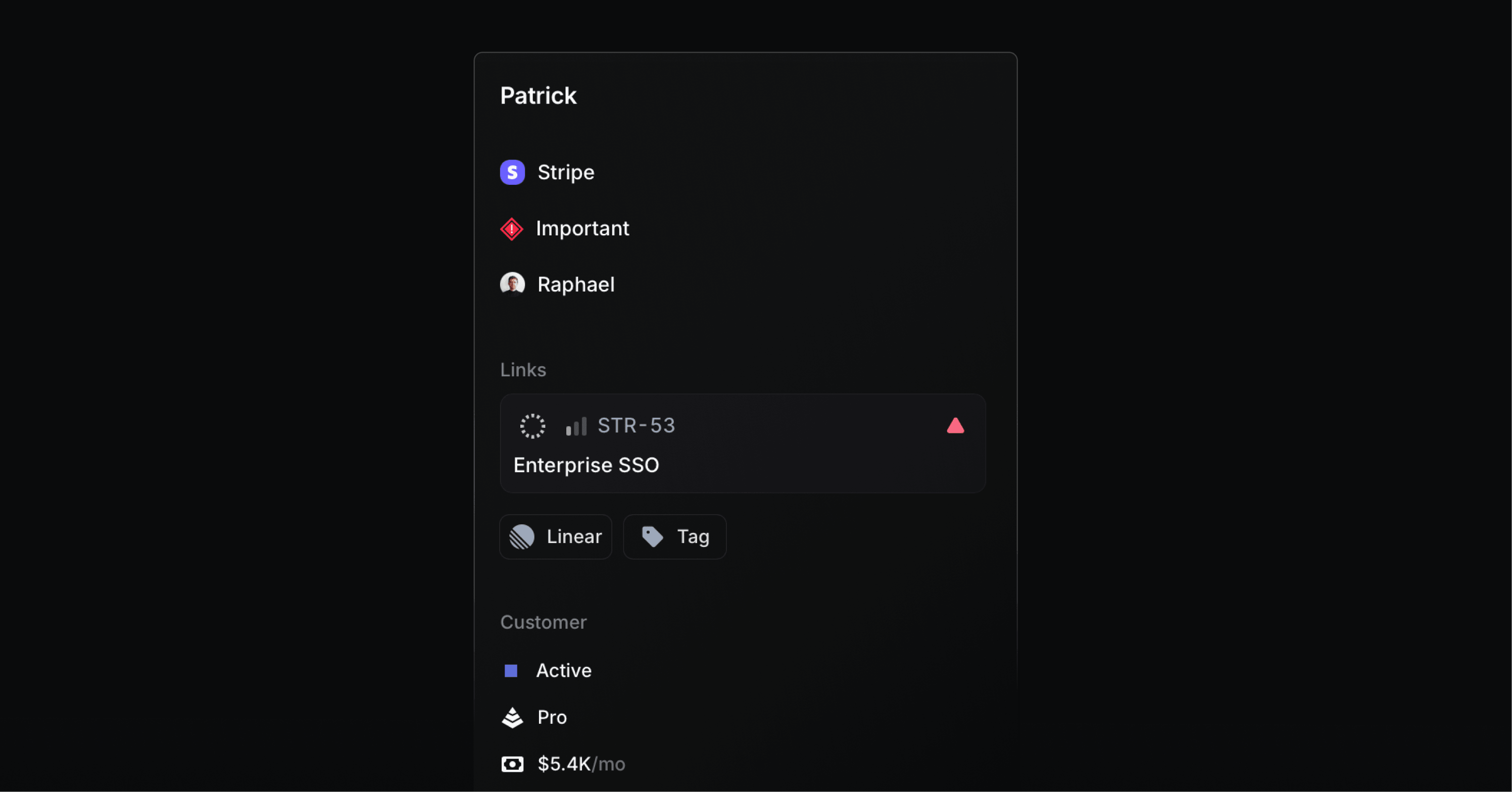
Productlane inbox showing a customer conversation with a linked Linear issue, an alternative to Zendesk for B2B SaaS

The Productlane inbox: every customer ticket auto-links to a Linear issue your engineering team is already working on.

The AI agent bills against resolutions, not seats

Productlane charges $0.79 per resolution, with included resolutions per plan tier: 50 on Starter, 100 on Pro, 200 on Scale. The AI fully resolves roughly 1 in 3 incoming conversations and drafts a reply on most of the rest. The math is predictable: at 1,000 monthly tickets and a 35% resolution rate on the Pro plan, the AI overage lands around $200 a month (250 resolutions beyond the 100 included, at $0.79 each). The same workload under Zendesk Suite Enterprise plus Advanced AI tends to land 3 to 5 times higher.

Linear is the source of truth

Every customer ticket links to a Linear issue bidirectionally. Status, assignees, comments, and project relationships sync in both directions. The AI agent files properly scoped Linear issues from incoming conversations, and well-scoped bugs can route directly to coding agents in Linear. When the linked issue ships, Productlane auto-drafts the reply that closes the loop on the customer ticket. Support work and engineering work stay in one system.

The help center, portal, and changelog are one product

The AI help center auto-drafts articles from shipped Linear issues, the public portal lets customers upvote feature requests, and the changelog ships from the same workspace. Teams leaving Zendesk typically consolidate three or four vendors into one when they migrate.

An inbox that feels instant

Productlane runs on Zero, the partial-sync engine we migrated to earlier this year. Every keystroke (assign, reply, snooze, tag, link to a Linear issue) lands instantly, even on workspaces with hundreds of thousands of tickets. The difference shows up in agent productivity within the first hour of trialing it.


The Zendesk migration playbook

Most B2B SaaS teams migrate off Zendesk in two to six weeks depending on inbox volume, channel coverage, and how many integrations have to be re-wired. The hidden cost is the parallel-run window, when context can get lost in the handoff. Below is the sequence we've watched the cleanest migrations follow.

  1. 1

    Find your renewal date first

    Pull the contract and read the auto-renewal clause. Most Zendesk contracts auto-renew 30 to 60 days before the anniversary date. If you miss the notice window, the migration becomes a 12-month wait. This is step one because it determines the entire timeline of the project.

  2. 2

    Export the data you actually need

    Zendesk exports tickets, users, organizations, and knowledge base articles as JSON. You don't need everything. Pull the last 12 months of tickets, all active users, all knowledge base content, and the macros your team uses daily. Triggers, custom field history, and dormant brands almost never come along cleanly. Plan to rebuild them on the new platform rather than reimport.

  3. 3

    Stand up the new platform in parallel

    Install the new platform alongside Zendesk for two to four weeks. Route a slice of new tickets (one product line, one channel, one team) through the new tool while Zendesk handles the rest. The parallel-run window is where you catch every workflow gap before cutover, with customers continuing to get answers from the system the agents already know.

  4. 4

    Retrain agents on the new keyboard model

    The single biggest cost of a migration is agent retraining. Most of the cost is muscle memory: assign, reply, snooze, tag, escalate. Block a half-day of training in week two, then have your two highest-volume agents work a full day in the new tool while a third stays on Zendesk for coverage. By week three, the new tool should feel as natural as Zendesk did.

  5. 5

    Cut over channels one at a time

    Migrate email last. Start with in-app chat, Slack, and any portal traffic. Email forwarding is the riskiest part of any migration because a misrouted address means dropped tickets. Update your support@ MX records on a low-volume day, monitor the inbox for a full business cycle, then close the Zendesk account.

  6. 6

    Run the new help center in production for 30 days before deprecating Zendesk Guide

    SEO is the silent risk in a help center migration. Keep the Zendesk Guide URLs live with 301 redirects to the equivalent articles in the new tool for at least 30 days, track the indexing in Google Search Console, and only retire the old subdomain once the new one is fully crawled and ranking.


What our customers say

“It transformed our engineering process to being massively more customer and feedback oriented. We can feel much more confident that the things we work on are delivering value, because we literally hear that they are from actual users before we commit resources to them.”
Jeff Escalante · Engineering Director, Clerk
“The tight integration with Linear makes our lives easier by reducing duplication.”
Brandon Bayer · CEO & Cofounder, Flightcontrol
“Our customers consistently get a real ‘wow’ experience when we showcase our support portal, roadmap, and communication workflows. It has really helped make our software feel much more mature and transparent.”
Morten Sønderlyng · Quiver
“The speed at which these guys develop new features is crazy! Productlane is truly one of those products where you feel like the team behind is reading your mind.”
Oliver Bahne · Francis

Frequently asked questions about leaving Zendesk

Two to six weeks for most B2B SaaS teams, with the variance driven by inbox volume, the number of channels, and how many integrations have to be re-wired. The migration itself is fast; the parallel-run window is what takes time, because that's where workflow gaps surface before cutover.

Most Zendesk contracts auto-renew 30 to 60 days before the anniversary date, on the same terms as the prior year. The exact window is in your master subscription agreement. Knowing the date and the notice period is the single most important thing to do before you start shortlisting alternatives, because missing it locks you in for another year.

Zendesk supports JSON exports of tickets, users, organizations, and knowledge base articles from the admin panel. Larger workspaces typically need the Zendesk API for full historical pulls. Custom field history, macros, triggers, and views often do not transfer cleanly; plan to rebuild those on the new platform rather than reimport.

If you handle the email forwarding window carefully and run the new platform in parallel for two weeks, almost none of your customers will notice. The places customers do notice are: a redesigned help center (positive, usually) and any re-themed customer portal. If you keep the support@ email address the same, the channel they use to reach you doesn't change.

On a pure per-seat basis, Freshdesk and Gorgias start lowest. For B2B SaaS specifically, the more relevant question is total cost including AI: Productlane starts at $29 per user per month (yearly billing) plus $0.79 per AI resolution, which typically lands well under Zendesk Suite Enterprise plus Advanced AI for the same workload. Run the math on your actual ticket volume rather than comparing list prices.

Open-source helpdesk tools like FreeScout, Chatwoot, and Helpy are free to self-host and cover the basic shared inbox and knowledge base. The trade-off is the hosting, security, and AI gap: you'll spend significant engineering time to get a free tool to the feel of a modern hosted platform. For most B2B SaaS teams, the cost of engineering time exceeds the cost of a paid platform.

Productlane has the deepest Linear integration on the market: bidirectional sync, an AI agent that opens properly scoped Linear issues from conversations, automatic routing of well-scoped bugs to coding agents in Linear, and help center entries that stay in sync with shipped work. Plain, Pylon, and Front also have native Linear integrations, but treat Linear as a downstream system rather than the source of truth.

Zendesk is a legacy help desk platform designed for enterprise CX teams running call-center workloads, with a data model and feature set built around that workflow. B2B SaaS support platforms (Productlane, Pylon, Plain) are designed for teams whose support volume is mostly bug reports, feature requests, and technical questions, with tight engineering-tool integrations (Linear, GitHub) and AI agents that bill per resolution. For most modern B2B SaaS teams, the second shape fits better.

“Zendesk competitors” and “Zendesk alternatives” describe the same shortlist: the platforms B2B SaaS teams pick instead of Zendesk. The ten worth shortlisting in 2026 are Productlane (the strongest fit for teams on Linear), Pylon (Slack-first), Plain (API-first), Intercom (B2C and ecommerce), Front (account-management teams), Help Scout (bootstrapped SMBs), Freshdesk (Zendesk-shaped help desk at a lower price), HubSpot Service Hub (CRM-led), Gorgias (ecommerce on Shopify), and Kustomer (mid-market omnichannel CX). Pick by where your customers actually live, not by feature checklist.


Leaving Zendesk: pick the platform that fits the next five years

Migrating off Zendesk is a project, but it's a project most B2B SaaS teams only do twice in their lifetime: once off Zendesk, once when they outgrow what came next. The trick is making the second migration the one you never have to do. Pick the platform whose shape fits where your team is going, not where it is today.

For B2B SaaS teams whose engineers live in Linear, Productlane is the support platform we wanted to use ourselves: a Linear-native ticket model, an AI agent at $0.79 per resolution, a self-updating help center, a public feedback portal, and a changelog, all in one tool with a sub-100ms inbox.

You can try Productlane for free, see pricing, or read our broader guide to the best customer support tools in 2026 for the wider category read. If you want help scoping a Zendesk migration specifically, get in touch and we'll walk you through it.

Customer support for modern companies

Omnichannel support engineered for AI. Built around Linear to turn customer messages into code instantly.

Productlane inbox with live chat conversation, thread list, and customer sidebar