Blog/The Best Customer Support Tool in 2026


The Best Customer Support Tool in 2026

Raphael Fleckenstein
Raphael Fleckenstein · May 16, 2026
The best customer support tool in 2026: Productlane
TL;DR

The best customer support tool in 2026 depends on who you are. Zendesk is still the safe pick for enterprise CX. Intercom is hard to beat for B2C and ecommerce, where support volume is mostly “where is my order” and not bug reports. Plain is a strong API-first choice. Pylon owns Slack-first B2B. For B2B startups with engineers in Linear who care about design and speed, we built Productlane. The rest of this article is a category read of the customer support software landscape, pros and cons for each tool (ours included), and a five-step framework for picking a support platform you won't have to migrate off in 18 months.

Picking a customer support tool in 2026 is a bigger decision than it used to be. The category has split. On one end, legacy ticketing suites that were designed for call centers a decade ago are now bolting on AI. On the other end, a new generation of tools is being built from scratch for technical B2B teams who run on Linear, GitHub, and Slack.

The worst outcome isn't picking the wrong tool. It's picking a tool you know you'll outgrow. Switching support platforms mid-growth costs real engineering time, breaks customer context, and forces your support team to re-learn their daily software. So the goal is to pick a platform you won't fight in a year, your customers will actually enjoy interacting with, and your team won't want to leave when they start their next job.

This guide walks through how we think about the customer support software category in 2026, an honest read on each contender (including the best Intercom, Zendesk and Front alternatives for modern B2B teams), and the framework we've seen teams use to pick the right support platform.

What actually matters in a customer support tool in 2026

Five years ago, the conversation was about omnichannel inboxes and SLA reporting. In 2026, the bar has moved. Here's what we see the best B2B teams optimizing for:

Native AI, not bolted-on AI

On Productlane today, the AI agent fully resolves roughly 1 in 3 incoming conversations end-to-end, and drafts a reply in seconds on most of the rest. That kind of resolution rate is only possible when the agent is wired into the same inbox, help center, and product context as the human team. Platforms that wedge in a chatbot as an upsell are not the same as platforms rebuilt around an AI agent from the ground up.

Deep Linear integration

If your engineering team plans, ships, and tracks work in Linear, your support tool has to live there too. Otherwise every bug report has to be copy-pasted by hand, and the loop between support and engineering quietly falls apart.

Multi-channel by default

54% of B2B buyers now prefer to resolve support in Slack, and enterprise buyers increasingly expect Microsoft Teams as a first-class channel. Email is still the workhorse. In-app chat, a public portal, and a help center are table stakes. A tool that's only good at one channel will leave half your customer experience on the floor. See how we handle this in omnichannel support.

Software that feels fast

Your support team lives inside this tool eight hours a day. Sluggish inbox loads, laggy keyboard shortcuts, and stale data quietly compound into hours of lost time every week. Performance is not a luxury. It's a productivity multiplier.

Design your customers feel

The support tool is the surface where your customers experience your company at their most frustrated. If your portal looks dated, if your help center feels heavy, if your changelog reads like a Jira export, that's the impression they leave with.


The customer support landscape in 2026

Here are the seven tools we think B2B teams should actually consider in 2026, side by side. We've tried to be fair: every tool gets the same shape (one pro, one con, channels, AI pricing, best for), including ours.

ToolStrongest atTrade-offChannelsAI pricingBest for
ProductlaneDeepest Linear integration, fastest UI in categoryYounger company, no WhatsApp yet, smaller marketplaceEmail, Slack, Teams, in-app, portal$0.79 / resolutionB2B teams on Linear
PlainAPI-first architecture, highly customizableRuns own ticket model parallel to Linear; thin on customer-facing surfacesEmail, Slack, Teams, Discord, chat$1.00 / resolution (Ari)API-first technical teams
PylonSlack Connect-first B2B workflowsThin on portal, changelog, help centerSlack, Teams, email, WhatsAppIncluded (no public pricing)Slack-first B2B support
FrontCollaborative email, account managementNo in-app messenger or true Slack inboxEmail, SMS, socialCopilot (per seat)Account management teams
IntercomIn-app messenger, mature AI agent (Fin)Feature sprawl; widget hard to make feel nativeIn-app, email$0.99 / outcome (Fin)B2C and ecommerce support
ZendeskEnterprise compliance, every integrationHeavy to implement; expensive at scaleAll channelsAI Agents (Suite plan)Enterprise CX orgs
Help ScoutLightweight shared inbox, easy setupNo native Linear, no Slack inbox, SMB-focusedEmail, chat, socialAI agents (per plan)Bootstrapped SMBs

Below the table, a slightly longer take on each, in alphabetical order.

Front

A collaborative inbox built around email. Great for sales-style account management, and Linear actually publishes a native Front integration that links conversations to issues and reopens the conversation when the issue ships. Weakness: it's fundamentally email-first, with no in-app messenger or true Slack support inbox, so teams that grow into chat-heavy workflows tend to migrate away.

Help Scout

A lightweight shared inbox with a clean knowledge base. Easy to set up and a stable, bootstrapped company behind it. They've added AI agents that they say resolve 73% of interactions on average. The ceiling shows up around Series B: no native Linear integration, no Slack inbox, and the product is built for email-first SMB support.

Intercom

Strong in-app messenger and a mature AI agent (Fin) that excels at deflecting ecommerce-style questions: lost orders, password resets, refund and billing questions, account recovery. That makes Intercom the right pick for B2C, consumer apps, and ecommerce, where support volume is mostly “where is my X” rather than bug reports or feature requests. The fit gets weaker for B2B SaaS: the product ships with around a hundred features most startup teams never touch, Fin is priced at $0.99 per outcome with a 50-outcome monthly minimum (which can spike unpredictably for high-volume teams), Linear integration is via the app store rather than first-party, and Fin can't resolve a bug because it has no way to file one in your issue tracker.

Plain

API-first support platform with a modern UI, popular with technical teams. Strong on Slack Connect, Microsoft Teams, Discord and email, with a native Linear integration. Plain has grown more complex over time and runs on its own ticket model rather than treating Linear issues as the source of truth, so support work and engineering work sit in two separate systems that have to stay in sync. Less depth on customer-facing surfaces like portals, changelogs, and feedback management, areas where teams typically end up stacking another tool.

Pylon

Slack-native specialist with strong traction in B2B and a native Linear integration that lets you link Pylon issues to Linear issues so they pass cleanly to product teams. Channel coverage is solid (Slack, Microsoft Teams, email, WhatsApp). Less depth on product-facing surfaces like a public portal, changelog, or help center.

Zendesk

The incumbent. Mature, enterprise-grade compliance, every integration imaginable (Linear sits in the marketplace as a third-party app). Heavy to implement (weeks), expensive at scale, and feels designed for a different era of support. A good fit if you have a dedicated CX ops team and enterprise buyers asking for SLAs.

Productlane

The customer support tool for companies on Linear, built for teams who care about software quality. Email, Slack, Microsoft Teams, in-app chat, a public portal, a help center, a changelog, and an AI agent, all in one app, with the deepest Linear integration on the market as the spine. The fastest UI in the category (we run on Zero for partial sync) and a design language that customers actually compliment. Teams typically switch from Intercom or a Linear plus Front plus changelog stack, and consolidate three or four tools into one.

Where we're honest about the trade-off: Productlane is a younger company than Zendesk or Intercom. We don't do WhatsApp yet, our marketplace is small, and if your buyer requires a SOC 2 auditor on speed dial and 24/7 phone support, we're probably not the right pick today. We're built for fast-moving B2B teams, not enterprise CX orgs.

Why teams pick Productlane

We started Productlane after seeing the same pattern at every fast-moving startup: engineering lives in Linear, customer signals are scattered across email, Slack, and in-app, and the support team is stuck stitching it all together by hand.

Productlane closes that loop. Every conversation (email, Slack, Microsoft Teams, in-app chat, portal) lands in one inbox. Every customer request can become a Linear issue in one keystroke, bidirectionally synced. Every shipped feature can be announced from the same tool, on your own changelog, on your own domain. And our AI agent resolves tickets end-to-end, using your own help center as context.

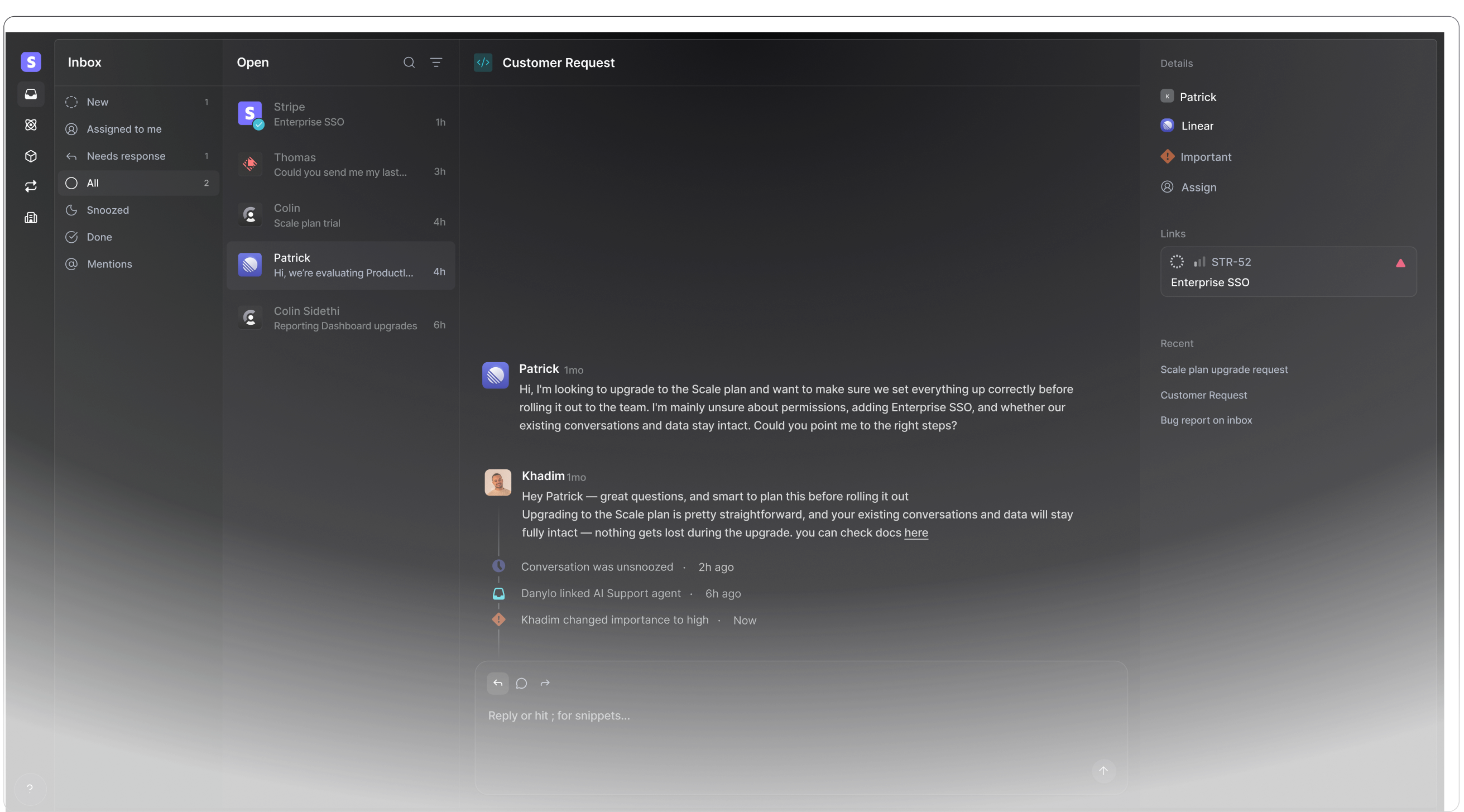
The Productlane inbox showing a customer conversation with a linked Linear issue

The Productlane inbox: email, Slack, in-app, and portal threads in one place, with the live Linear issue attached on the right.

The deepest Linear integration on the market

Customer needs map to Linear issues with full bidirectional sync, including status, assignees, comments, and project relationships. Your engineers never leave Linear; your support team never leaves Productlane. That part is table stakes, and a few other tools do it. Where Productlane goes deeper:

  • Your help center stays in sync with shipped work automatically. When a Linear issue moves to Done, Productlane drafts the help center update for you, so your docs reflect what actually shipped instead of drifting behind by months.
  • The AI agent creates Linear issues from conversations. When a customer reports a bug or asks for a feature, the AI recognizes it, opens a properly scoped Linear issue with the customer context attached, and links it back to the conversation.
  • Small bugs get routed to coding agents in Linear automatically. For well-scoped bugs, the AI assigns the new Linear issue directly to a coding agent, so a fraction of your bug backlog moves from customer report to PR without a human in the middle.
  • AI drafts are grounded in your Linear workspace. When the agent drafts a reply, it pulls from your projects, issues, and roadmap, so it actually knows what your team is working on, what shipped last week, and what's coming next. No more replies that contradict your roadmap.

An AI agent that's actually useful

Our AI agent reads your help center, your past conversations, and your product context. It drafts replies, deflects repetitive tickets, and hands off to a human the moment it's uncertain. Pricing is resolution-based and transparent: 50 to 200 resolutions are included with every plan, and additional resolutions are $0.79 each, roughly 20% less than Intercom's Fin.

Speed as a feature

We moved Productlane to the Zero sync engine this year specifically so that the inbox feels instant even for workspaces with 100k+ rows. Keyboard shortcuts cover every action. Mobile actually works.

Everything customer-facing, in one tool

Public portal, help center, AI changelog, and feedback boards, all included, all on your own domain, all designed to make your product feel more mature and your customers feel more taken care of.

What our customers say

“It transformed our engineering process to being massively more customer and feedback oriented. We can feel much more confident that the things we work on are delivering value, because we literally hear that they are from actual users before we commit resources to them.”
Jeff Escalante · Engineering Director, Clerk
“The speed at which these guys develop new features is crazy! Productlane is truly one of those products where you feel like the team behind is reading your mind. Along with Superhuman, Productlane is THE tool I recommend to every startup team I know.”
Oliver Bahne · Francis
“The tight integration with Linear makes our lives easier by reducing duplication.”
Brandon Bayer · CEO & Cofounder, Flightcontrol
“Productlane was a game changer for us. We love the Linear integration to turn customer feedback directly into tickets. And recently we also started using the email integration, so we can all track and engage in support communication.”
Jana Schellong · Co-founder, beams
“Productlane keeps us shipping what our customers want. The ease of receiving valuable customer feedback resonated with me personally as a product manager. Productlane is a must-have tool for all B2B SaaS products.”
Peer Rahne · CPO at All Quiet
“Our customers consistently get a real ‘wow’ experience when we showcase our support portal, roadmap, and communication workflows. It has really helped make our software feel much more mature and transparent.”
Morten Sønderlyng · Quiver

Productlane vs other customer support tools

Most of the comparison searches we see in the wild are head-to-head: Productlane vs Intercom, Productlane vs Plain, Productlane vs Zendesk. Short answers for each.

Productlane vs Intercom

The line between Productlane and Intercom is what your support volume actually looks like. Intercom is polished for ecommerce and consumer flows: a strong in-app messenger and a mature AI agent (Fin) that excels at deflecting questions like “where is my order,” “how do I reset my password,” or “why was I charged twice.” If that's most of your volume, Intercom is hard to beat. For B2B SaaS teams, the picture is different. Most tickets are bug reports and feature requests, and resolving those means filing a Linear issue, tracking it to a PR, and replying to the customer when it ships. Intercom can't close that loop. It doesn't live in Linear, so the work has to be copy-pasted out by hand, and Fin can't resolve a bug it has no way to file. Productlane is built for exactly that workflow: the AI agent recognizes bug reports and feature requests in incoming conversations, opens properly scoped Linear issues with full customer context, routes well-scoped bugs to coding agents in Linear, and notifies the customer when the fix ships. That's the difference between a deflected ticket and a shipped feature. If your engineers live in Linear and your support volume is bugs and feature requests, Intercom isn't a fit.

Productlane vs Plain

Plain is API-first and popular with technical teams. Productlane is the better Plain alternative if you want Linear issues to be the source of truth (rather than running a parallel ticket model), and if you also need a portal, help center, changelog, and feedback boards in the same tool. Plain wins if you want to build a heavily customized support experience on top of a GraphQL API.

Productlane vs Zendesk

Zendesk is the incumbent: enterprise compliance, every integration, every channel. Productlane is the better Zendesk alternative if you're a fast-moving B2B startup who finds Zendesk heavy, expensive, and built for a different era of support. Zendesk is still the safe pick if you have a dedicated CX ops team and enterprise buyers asking for SLAs and 24/7 phone coverage.

Productlane vs Front

Front is a collaborative email inbox with a native Linear integration. Productlane is the better Front alternative if you need a true Slack support inbox, an in-app messenger, or a customer-facing portal and changelog. Front wins if your team is mostly account managers running email and SMS.


How to choose the best customer support tool for your team

A short decision framework that we've seen work for almost every B2B team we talk to:

  1. 1

    Start with where your engineering team lives

    If they live in Linear, your support tool must integrate natively. Anything less and the support ↔ engineering loop will be your biggest source of friction within a year.

  2. 2

    List the channels you actually need

    Be honest. Email, Slack, in-app chat, a public portal: pick a tool that does the ones you need natively. Bolt-ons are a tax.

  3. 3

    Test the AI on a real ticket

    Don't take demo-day numbers at face value. Connect the tool to a real backlog of tickets and see how the AI handles them with your help center as context. Then check pricing for that volume.

  4. 4

    Make your team use it for an hour

    Speed and design are not adjectives. They're things your support team will feel within fifteen minutes. If it feels slow or ugly in a trial, it'll feel worse a year in.

  5. 5

    Look at what's customer-facing

    Your portal, your help center, your changelog: those are surfaces your customers actually see. Pick a tool whose customer-facing design you'd be proud to put your logo on.

Frequently asked questions

It depends on stack and stage. For B2B startups with engineers in Linear and customers in Slack and email, Productlane is built for you. For B2C, consumer apps, and ecommerce, where support volume is mostly order tracking, refunds, and account recovery, Intercom is hard to beat. For enterprise CX orgs with strict SLAs, Zendesk is still the safe pick. For bootstrapped SMBs on email, Help Scout is solid.

Productlane has the deepest Linear integration on the market: bidirectional sync, AI agent that opens properly scoped Linear issues from conversations, automatic routing of well-scoped bugs to coding agents in Linear, and help center entries that stay in sync with shipped work. Plain, Pylon and Front also have native Linear integrations, but treat Linear as a downstream system rather than the source of truth.

Pricing for AI support agents in 2026 ranges from about $0.79 to $1.00 per resolution. Productlane is $0.79 per resolution (roughly 20% less than Intercom's Fin at $0.99 per outcome, and 21% less than Plain's Ari at $1.00). Zendesk and Pylon bundle AI resolutions into higher-tier plans without per-unit transparency.

Yes, especially for B2B SaaS teams whose support volume is mostly bug reports and feature requests. Intercom is built for ecommerce-style deflection (lost orders, password resets, billing questions) and Fin is great at those. It can't close the loop on a bug, because it doesn't live in Linear. Productlane does: the AI agent files Linear issues from conversations, routes well-scoped bugs to coding agents, and replies to the customer when the fix ships. If your support volume looks more like a product backlog than a help desk, Intercom isn't a fit.

Both target technical B2B teams. Productlane is better if you want Linear issues to be the spine of your support workflow and you also need a portal, help center, changelog and feedback boards in one tool. Plain is better if you want to build a heavily customized support experience on top of a GraphQL API.

Most B2B teams we've watched migrate in 2 to 6 weeks depending on inbox volume, channel coverage, and how many integrations have to be re-wired. The hidden cost isn't the setup, it's the month of degraded customer experience while two systems run in parallel and context gets lost in the handoff. That's the cost the article above is mostly trying to help you avoid paying twice.


Choosing the best customer support tool for your team in 2026

Pick a customer support platform you won't have to migrate off in 18 months. Every support migration we've watched closely costs roughly a quarter of engineering time, a month of degraded customer experience while two systems run in parallel, and a stack of context lost in the handoff. The real question is less “which tool wins this year?” and more “which support platform will still fit when our team is twice the size?”

If you're a 200-person CX org running enterprise contracts with strict SLAs, Zendesk is the safe pick and probably still will be in three years. If you sell to consumers and most of your support volume is order tracking, refunds, and account recovery rather than bug reports, Intercom is hard to beat.

If you're a fast-moving B2B startup with engineers in Linear, customers in Slack and email, and a strong opinion about design and speed, we built Productlane for you. It's the support tool we wanted to use ourselves, and the one our customers tell us they wish they'd switched to sooner. If you're early-stage, we also have a startup program.

You can try Productlane for free, see pricing, or read more about how we think about shared inboxes, Slack for customer support, and inbox zero.

Customer support for modern companies

Omnichannel support engineered for AI. Built around Linear to turn customer messages into code instantly.

Productlane inbox with live chat conversation, thread list, and customer sidebar