B2B customer support runs on named accounts, fewer but higher-stakes conversations, a steady stream of bug-and-feature volume, Slack Connect channels, and SLAs tied to contracts. B2B customer support software has to carry account-level context, cover the channels your customers actually use, route engineering work to Linear or GitHub, and put an AI agent on top of a current help center.
Most customer support advice is written for B2C. High ticket volume, anonymous buyers, a refund flow, a returns policy, a queue you grind down. B2B SaaS support looks nothing like that. You have a few hundred accounts, not a few hundred thousand shoppers. A single conversation can touch a renewal worth six figures. The question on the other end is rarely “where is my order” and far more often “your webhook stopped firing after the deploy and our integration is down.” Picking b2b customer support software with B2C assumptions baked in is how teams end up fighting their tools.
This article is about the B2B specifics: what makes the work different, what the software has to do because of those differences, and how the main categories stack up. For the broad market overview, see our guide to the best customer support tools, and if you are leaving an incumbent, the best Zendesk alternatives piece covers migration. Here we stay focused on B2B.
The shape of the work changes everything downstream, from the data model to the SLA clock to who answers the ticket. Five differences do most of the heavy lifting.
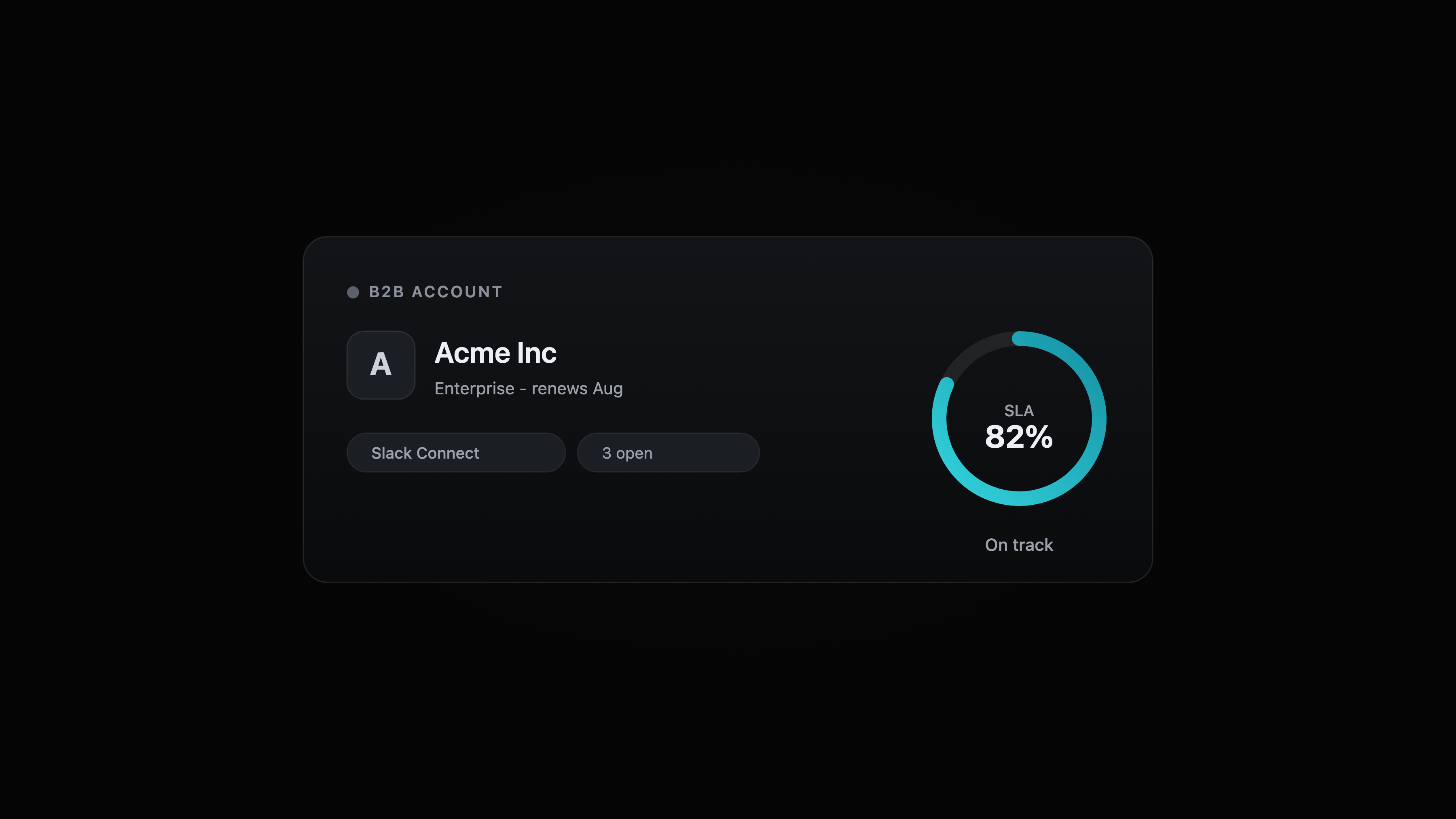
In B2C the ticket is the unit of work and the person behind it is mostly disposable context. In B2B the account is the unit. A request from Acme matters because Acme is on a $90k annual plan, renews in March, and has three open feature requests already. The agent needs the plan, the seat count, the renewal date, the CSM, and the open threads for that company in view before they type a word. Support that treats each message as a fresh anonymous ticket loses the thread the moment a different agent picks it up.
A B2B team might handle a few dozen conversations a day where a B2C team handles thousands. Volume metrics matter less; resolution quality matters more. One mishandled conversation with a champion at a key account can cost a renewal. The work rewards depth over speed: getting the answer right, looping in the right engineer, and following up after the fix ships.
B2B SaaS support is heavy on bug reports and feature requests, not password resets. A large share of inbound is really product work in disguise: an API edge case, a regression after a release, a customer asking for a capability that belongs on the roadmap. That means support cannot live in a silo away from engineering. The handoff to the team that writes the code has to be a keystroke, and the answer often depends on a Linear issue or a GitHub commit.
B2B customers expect to reach you where they already work. For a lot of accounts that means a shared Slack Connect channel, not a form on a help site. The catch is that conversations in Slack vanish from your support system unless the tool ingests them as real threads with the same account context, SLA tracking, and assignment as email. Our breakdown of Slack for customer support goes deeper on the tradeoffs.
B2B SLAs are contractual, often tiered by plan, and they apply per account rather than as a single global target. Enterprise gets a one-hour first response, mid-market gets four hours, and the clock has to know which is which. The software has to surface the SLA status on the conversation, escalate before a breach, and report on attainment per account at renewal time.
Those differences translate into a short list of non-negotiable capabilities. A tool can be excellent for B2C and still be the wrong pick for a B2B SaaS team because it misses one of these.
Every conversation should open with the account next to it: plan, seats, renewal date, owner, lifetime value, and the open threads and feature requests for that company. The team should be able to read support history by account, not just by individual ticket, so a new agent can pick up where the last one left off.
Email, an in-app widget, and Slack Connect all need to land in one inbox as first-class threads, carrying the same account context and SLA clock wherever the message came in. The omnichannel support guide covers how to unify channels without losing context, which is the part teams underestimate.
Because so much B2B volume is product work, the support tool has to file an issue to your tracker in one step, link it back to the conversation, and reopen the loop when the fix ships. The tighter that integration, the less work falls through the cracks between support and engineering. A bug reported by three accounts should be one Linear issue with three linked threads, not three orphaned tickets.
An AI agent is only as good as the content behind it. For B2B the help center has to stay current with a product that ships weekly, which is hard to do by hand. An AI support agent backed by a self-updating help center can resolve the repetitive technical questions and draft the rest, freeing humans for the conversations that move renewals. Our guide to AI ticketing systems explains how the triage-route-resolve loop works.
The market sorts into a few camps. None is wrong; they optimize for different shapes of team. The comparison below is a starting point, not a verdict, and pricing moves, so confirm current numbers before you commit.
| Tool | Built for | Engineering loop | AI agent |
|---|---|---|---|
| Productlane | B2B SaaS teams on Linear | Bidirectional Linear, AI files scoped issues, shipped issue drafts the reply | $0.79 per resolution on a self-updating help center |
| Pylon | B2B teams with heavy Slack Connect support | Issue tracker integrations | AI features on knowledge base |
| Plain | Developer-first B2B teams wanting an API-native inbox | Integrations and API for custom routing | AI assist features |
| Front | Collaborative shared inboxes across teams | App integrations, no native engineering tracker | AI answers and drafting add-ons |
| Zendesk | High-volume support across B2C and B2B | Marketplace apps for Jira and others | AI add-ons priced per resolution |
Built for B2B SaaS teams whose engineers run on Linear. The engineering loop is the lead: a customer issue links bidirectionally to a Linear issue, engineering works it in Linear, and when the issue ships the loop closes itself and the customer hears back automatically. On top of that, the AI agent files scoped issues from a conversation, clears roughly a third of incoming conversations on a self-updating help center, and drafts replies for the rest. A public feedback portal with upvoting, a roadmap, and a changelog rounds it out so the product loop lives in the same tool. Per-seat plans open at $29 a user each month on the annual option.
Start from where your customers actually talk to you and how much of your inbound is engineering work. Three questions narrow the field fast.
If most support runs through Slack Connect, weigh tools that treat Slack as a first-class channel with account context, not a forwarded email. If it is in-app and email, weigh the widget and the inbox speed. Map your real channel mix before you shortlist.
If a large share of tickets become bug reports and feature requests, the engineering loop is the deciding feature. A native, bidirectional link to your tracker saves more time than any other single capability, because it removes the copy-paste tax on every technical thread.
An AI agent on stale docs answers confidently and wrongly, which is worse than no agent. For a weekly-shipping product, prioritize a help center that updates itself from what you ship, so the agent and your customers read the same current source. Run a paid trial on your real inbox and read the AI transcripts before you trust the deflection number.
We built Productlane for the exact shape of B2B SaaS support: named accounts, technical volume, and a product team on Linear. The Linear-native engineering loop is the core of the tool. A customer issue links bidirectionally to a Linear issue, your engineers work it in Linear where they already live, and when the issue ships the loop closes on its own: the thread reopens and the customer gets told their fix is live, without anyone going back to copy the update across. A bug raised by three accounts becomes one Linear issue with three linked threads, so nothing falls between support and engineering.
The rest of the platform feeds that loop. Every conversation opens with account context, and the AI agent files scoped Linear issues straight from a thread, settles around a third of incoming conversations on its own, and drafts replies for the rest. The self-updating help center keeps the agent grounded in current docs, the in-app widget speaks 47 languages, and the inbox runs on Zero with sub-100ms interactions.
Feedback completes the picture. The public feedback portal gives customers upvoting, a public roadmap, and a changelog in the same tool, so the feature requests that arrive through support turn into prioritized, visible product work. Seats begin at $29 a user each month on the yearly plan; see the pricing page for the current plans.
B2B customer support software is a platform built for supporting business accounts rather than individual consumers. It centers on account-level context (plan, seats, renewal, owner), covers channels like email, in-app widgets, and Slack Connect, tracks contractual SLAs per account, and connects support to engineering so bug reports and feature requests reach the team that ships the product.
B2B handles fewer but higher-stakes conversations tied to named accounts, where one mishandled thread can affect a renewal. The volume skews technical (bugs and feature requests rather than returns), Slack Connect is often a primary channel, and SLAs are contractual and tiered by plan. B2C is high-volume, mostly anonymous, and transactional.
A large share of B2B SaaS support is product work in disguise. A native, bidirectional link to a tracker like Linear lets an agent file a scoped issue from a conversation in one step, link it back, and reopen the thread when the fix ships. Productlane files scoped Linear issues from the AI agent and auto-drafts the closing reply when the linked issue ships.
The right ones do. For many B2B customers Slack Connect is the primary channel, so the tool should ingest Slack conversations as real threads carrying the same account context, SLA clock, and assignment as email, rather than treating them as forwarded messages that lose context.
An AI agent can resolve the repetitive technical questions and draft replies for the rest, provided it sits on current documentation. Productlane's AI agent resolves about one in three conversations end to end at $0.79 per resolution on a self-updating help center, which keeps it accurate for a product that ships weekly.
Pricing models vary: per-seat, per-AI-resolution, or a mix. Productlane starts at $29 per user per month billed yearly, with the AI agent priced at $0.79 per resolution. Always confirm current pricing with each vendor, since plans and AI add-on costs change.
B2B customer support rewards account context, channel coverage, a tight engineering loop, and an AI agent grounded in current docs. Pick the tool that matches your channel mix and how much of your inbound is product work, and run a paid trial on your real inbox before you commit.
If your engineers run on Linear and you want support, feedback, and a changelog in one fast tool, see what Productlane does and check the pricing to get started.
Omnichannel support engineered for AI. Built around Linear to turn customer messages into code instantly.

A B2B support platform with a strong focus on Slack Connect as a primary channel, alongside email and other inputs. A good fit for teams whose customer relationships already live in shared Slack channels and who want account-level context across them.
An API-native support inbox aimed at developer-first B2B teams. It leans on integrations and a flexible API for custom routing, which suits teams that want to wire support tightly into their own systems and tooling.
A collaborative shared inbox that spans support, sales, and operations. Front shines when several teams work the same inboxes and want assignment, comments, and shared drafts. Its engineering handoff runs through app integrations rather than a native tracker.
The incumbent, built to handle high volume across both B2C and B2B. Mature, broad, and deeply configurable. Its data model and pricing come from the call-center era, and the engineering loop runs through marketplace apps. For B2B SaaS teams that find it heavy, our Zendesk alternatives guide covers the move.